
buy book at amazon
Prelude to Volume II
How would a nerd date an older super-model? Using carbon-14. –Unknown
Today I saw an ad that said, "Radio for sale, $2, volume stuck on full." I thought to myself, "I can't turn that down." –Unknown
All battles are first won or lost in the mind. –Joan of Arc
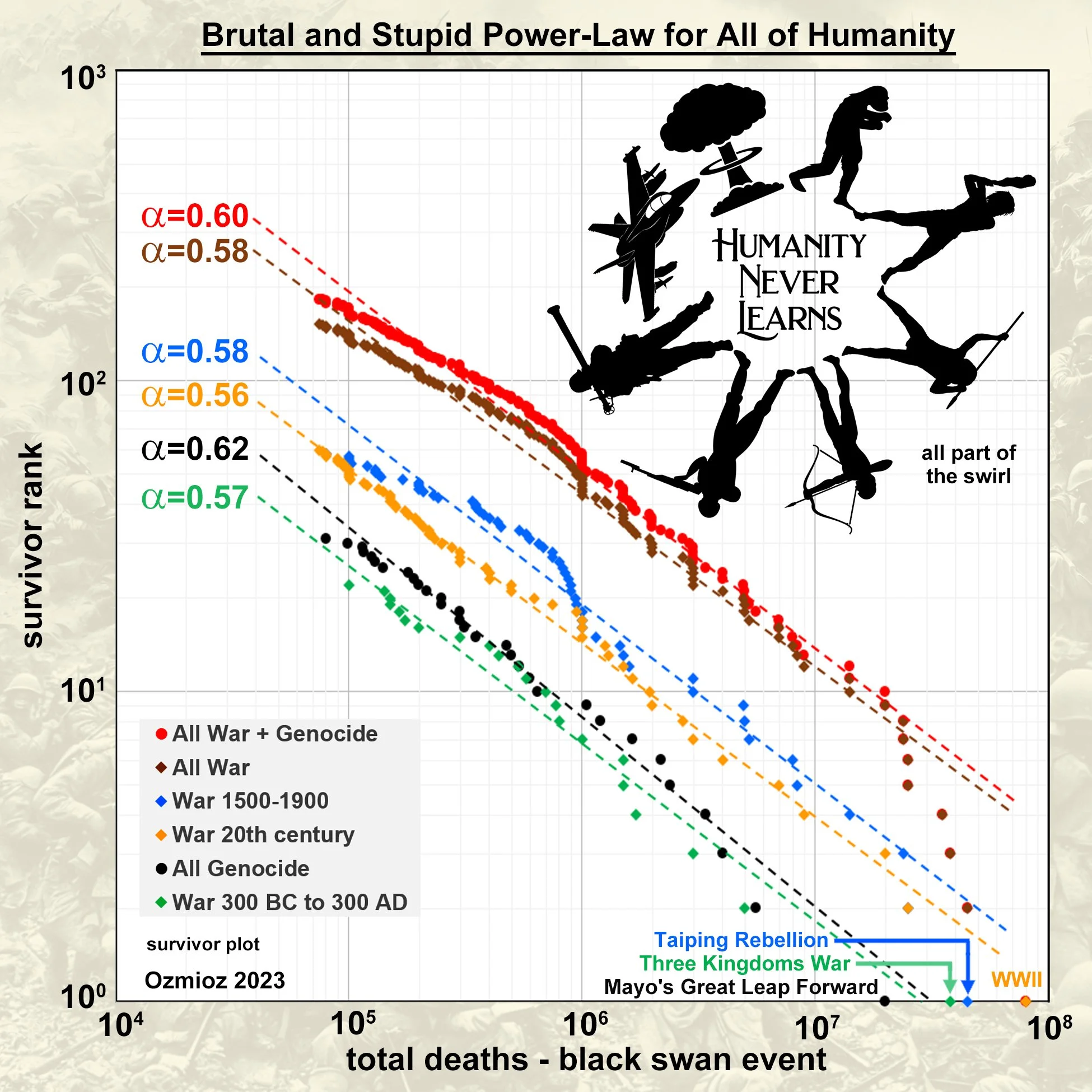
During our intellectual wanderings during Covid we stumbled upon the data analysis fact that war and genocide have the same statistics as earthquakes if you equate number of deaths as earthquake energy (see figure).
After plotting that data our intellectual wanderings went in a totally different direction. We started studying power-laws. Besides war and earthquakes, we quickly learned that populations of cities, sizes of countries, sizes of businesses, people’s incomes, people’s wealth, and the number of followers of top social influencers obey power law statistics. Who knew? We were slowly coming to the conclusion that human migration, the flow of money, and social interactions are in some type of turbulent limit or follow some kind of fractal dynamics or both.
We then watched an interview with Benoit Mandelbrot, the “father of fractal” geometry. During the interview he talks about Vilfredo Pareto. In our opinion he is one of the most fascinating characters of all time. Vilfredo Pareto is born in 1848 when uprising are sweeping across Europe. He grows up to be an Italian engineer who hates bureaucrats and communists. Half way through his career he starts studying economics because he couldn’t get any work done due to all the regulations. Using statistics, he discovers 20% of the people own 80% of the land. This becomes known as the Pareto rule. The Pareto rule is the first time anyone popularizes a power-law distribution. In 1906 he went on to write the first modern textbook on economics, “Manual of the Political Economy”. A book driven more by data than by philosophy. Then in 1916 he writes the first textbook ever on sociology, “The Mind and Society”. A book driven more by philosophy than by data. In that book he popularizes the word “elites”. Vilfredo believes war and starvation are because over time the “elite” class becomes soft. They lose control of all the social turbulence constantly churning on the streets. Revolts happen. Wars expand. Death follows. To stop this turbulent cycle of war and deaths the elites must stay strong and impose their will. One of Vilfredo’s students is a young Mussolini. Because of this Vilfredo Pareto is known as the father of fascism. Pareto dies in 1923, and never sees that that the rise of fascism leads to WWII and the largest “black swan” event in all human history. We find this crazy. You can’t make this stuff up. Surprisingly, the story of Pareto’s life isn’t taught in most schools.
A few months later we watched an interview with Geoffrey West promoting his 2017 book, “Scale: The Universal Laws of Life, Growth, and Death in Organisms, Cities, and Companies”. We then read the book. Great book. Turns out West is part of a small group of physicists that have been studying society as a turbulent system. It is important to note turbulence is not random. Certain scaling laws appear naturally.
As a side note within “Scale”, West mentions a Lewis Fry Richardson (1881-1953) who is a mathematician, weatherman, and the father of modern meteorology. Richardson was also obsessed with war. He believes we can predict wars like we can predict the weather. In Volume II we will summarize Richardson’s notes.
Volume II is broken into two main parts. The first part is a data dump. We review all kinds of power-laws, and then all kinds of scaling laws. The second part of the book is our effort at building up a collection of mathematical meteorological tools for describing war, politics, and economics. A few highlights:
· for a system to stay turbulent, energy must constantly feed into the system, else the turbulence will dissipate away. For the weather the energy feed is from the Sun. For humanity the energy feed is babies and we all must make a living
· East Asia has had some of the largest “black swan events” throughout human history (see figure plus the Mongol invasions). The only thing that makes East Asia special is Asia is larger and more people live there
· with a few simple rules and a simple renormalization method, we can model human migration and the formation of cities. We call this our “interacting sandpile model”. Our simulations and the data agree perfectly. We can even fit the small village part of the real data log-normal distribution. What’s great about this model is there is only one key parameter, the city-city interaction strength
· to repeat, we’ve concluded that human civilization is in the turbulent limit where local enclaves form vortex-like structures. (We could instead call these sandpile-like structures. Still working through how best to describe civilization’s turbulent dynamics.) These slow-moving vortex-like structures form hierarchies of larger vortex-like structures. Countries are a result of these hierarchies. Countries grow and dissipate just like vortices in a turbulent river
· we were having some issues modeling the turbulence of politics, pack behaviors, and gang vortex formations. To get our bearings, we decided to first model the size of companies, management structures, and salaries. Treating companies as organisms and individuals as actors all trying to maximize their salaries, we can fit the real-world data. We get the correct power-law for company sizes. We get the correct power-law for individuals’ salaries. What is crazy is within this simple model is that the hierarchy structures for managers in large companies naturally become top-heavy after 60 to 100 years. Once the company becomes top-heavy it quickly collapses in size. That observation is consistent with the history of a lot of fallen companies. It is also consistent with Vilfredo Pareto perspective on leadership
· at this point our high-end computer died. We decided to finish Volume I before continuing on with Volumes II and III.
The takeaway is Volume II is awesome if you like data, statistics, scaling laws, and math. Truth be told, marketing is not our strong suit. With that powerful sales pitch we are confident 10 to 20 people will read it. A few might not even be nerds.