

During the Covid Pandemic we stumbled upon I. M. Suslov’s revolutionary idea that considers humor from the brain’s perspective. In summary, humor helps us forget “incorrect” inputs, making us smarter. For artificial intelligence programmers, this suggests that humor helps eliminate AI hallucinations. There is one snag with this theory. We remember jokes. But Suslov’s insight sparked our curiosity.
The more we read, the more we discovered numerous people have studied humor from all kinds of perspectives. This list includes Aristotle, Freud, and Darwin. We soon realized all theories of humor fail at some level. No one really knows why we laugh.
We then asked the question, “How is our voice box wired up to our brain?” We should have never asked that question. That question, along with our background as a camera designer who is also interested in self-driving car systems, led us down a six-year odyssey. We spent two to three hours every morning digesting over 1,000 research papers while reverse engineering how our brain is wired together. We discovered there are multiple competing paths from our brain to our voice box. One path is for speech, the others for laughter.
We discovered the power of “mirror neurons” and the origin of empathy. We deciphered the neurological wiring between long-term, short-term, and working memory. We figured out how combative humor, nurturing humor, and sexual humor work at a system level. Also, how resonances amplify laughter when we recall memories with old friends.
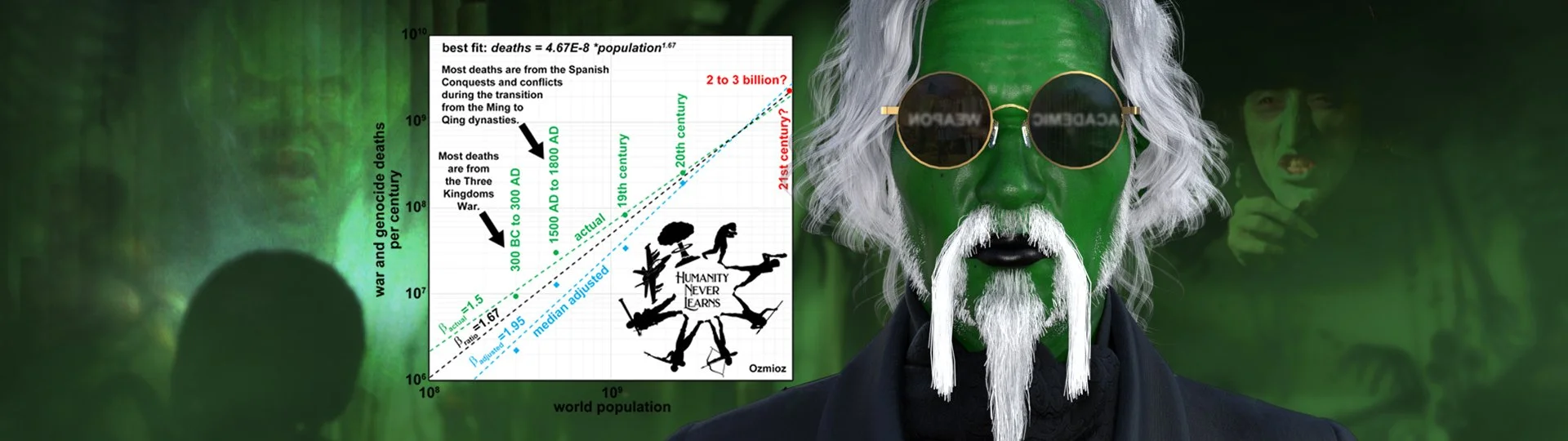
We then applied Darwin’s “Theory of Opposites” and studied the evil laugh. By accident we discovered deaths from war and genocide have the same statistics as earthquakes. Unfortunately, these statistics predict 2 to 3 billion people will die this century. Description of the evil laugh is in Volume I. Statistical details are in Volume II.
For any drug addict or alcoholic, the first step on the road to recovery is to admit you have an addiction problem. The human race needs to look in the mirror and admit we have a war and genocide problem.