Tell Them What You Are Going To Tell Them
All words are made up. –Thor
People are concerned about a new Tik Tok craze where teenagers video themselves dropping heavy objects on their feet. Sometimes you have to let evolution run its course. –Jimmy Fallon
Laughter is a bodily exercise, precious to health. –Aristotle
We have much admiration for scientist and professor John Wilkinson. He is a happy lovable dork with an infectious laugh, who cares for his students, and an unmatched passion for science. His advice for giving a talk is “Tell them what you are going to tell them, tell them, then tell them what you told them.” Here is a rapid-fire summary of what we believe are the most important takeaways from Volume I:
· evolutionarily, our brains are Always rewiring And repurposing. Ar Ar
· there are many types of memory. The two main categories are
o repetitive actions. Darwin referred to these as learned reflexes and habits. Researchers today refer to these as procedural memories. Intentional learned reflexes include swimming, walking, and eventually talking. Unintentional reflexes include scratching our heads when thinking, constantly checking our iPhones, swearing, and sometimes laughing. Repetitive learned actions are the main function of our brain’s basal ganglia system
o event memory. These are our ability to remember one-time events. They evolved from our survival need to find food and are tied closely to our emotions. Event memory is the main function of our brain’s limbic system
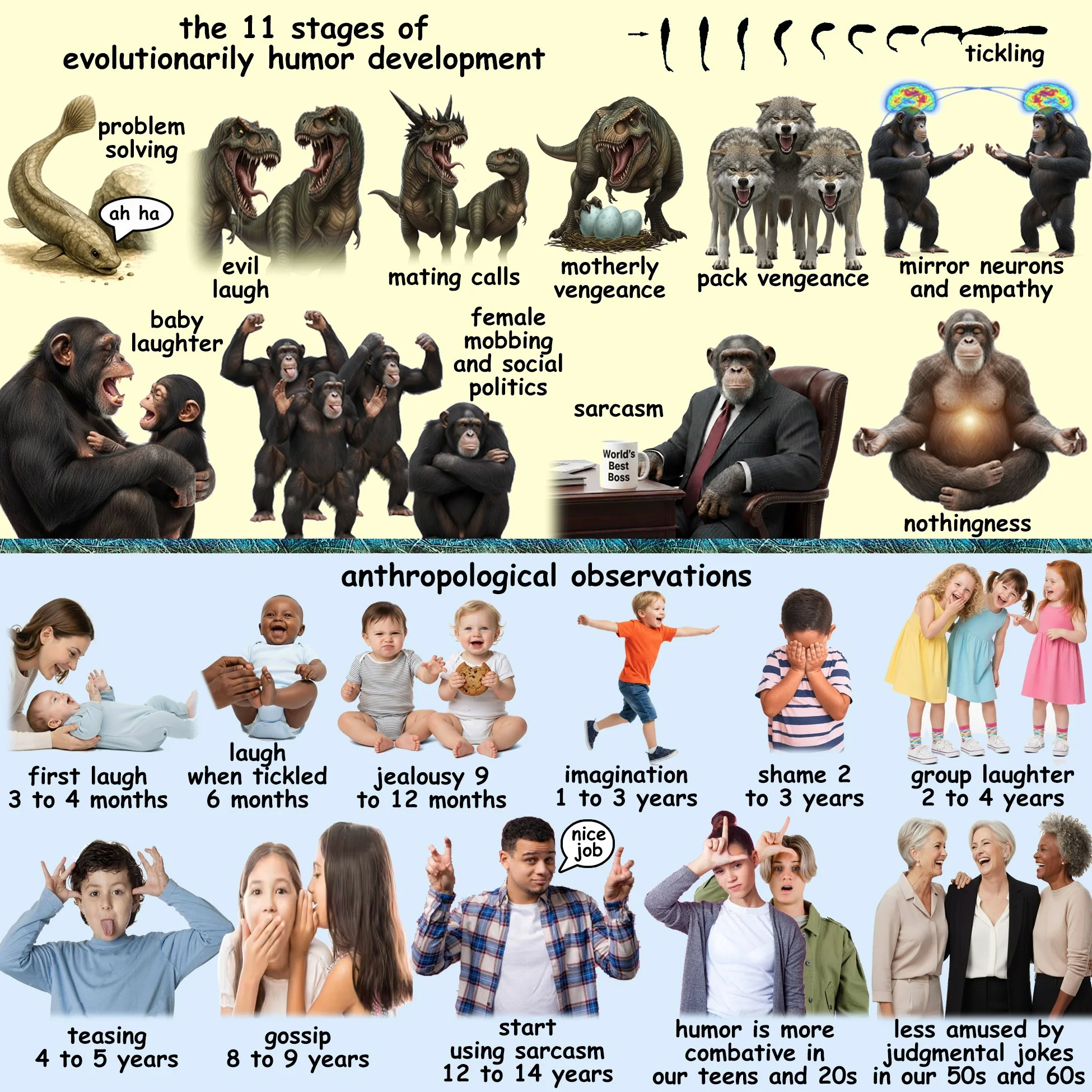
· learning repetitive tasks evolved from our sense of taste and touch. Important evolutionary repetitive tasks include eating and later the c-startle reflex. The c-startle reflex allows fish to swim away from objects and predators. Tickling is an evolutionary echo of the c-startle reflex (humor stage 1)
· our emotions, event memory, and our limbic system evolved from our sense of smell
o we know this because our olfactory nerves in our nose wire directly to our olfactory bulbs. Signals from these bulbs are sent to our event memory funnel (entorhinal cortex, 28,34,27), event memory core (hippocampus), emotional dispatch center (amygdala), and hormone control center (hypothalamus)
o grid cells are neurons found in our event memory funnel (entorhinal cortex, 28,34,27). Grid cells fire or don’t fire depending on where we stand in a room. This grid mapping of our surroundings allows us to navigate
o we often say “ah ha” or “mmm” when we see food or solve a riddle. Evolutionarily this goes back to our ancestors solving the food problem (humor stage 2)
· our evil laugh and survival by intimidation emerges to defend against predators (humor stage 3)
· mating calls and survival of the sexiest emerge from the evil laugh (humor stage 4)
· motherly-vengeance and survival of the nurturers also emerge from the evil laugh (humor stage 5)
· pack-vengeance and survival of the most loyal emerge from motherly-vengeance (humor stage 6)
· the “evil laugh” and the “friendly laugh” are a form of communication, telling members when to attack and when to relax. Opposite behaviors are natural because the wild is a very binary world where others are either friend or foe
· mirror neurons emerge enabling our ability to laugh, socialize, and attack in packs (humor stage 7)
· mirror neurons enable and a new emotional capability called empathy
· baby laughter emerges to show intelligence to our mothers, and to the group (humor stage 8)
· bad girl behavior is a signal to leave the pack and evolves to minimize inbreeding
· female mobbing is a repurposing of pack-vengeance laughter to address misbehaving males (humor stage 9)
· complaining (9a), compliments (9b), shame (9c), and mocking (9d) evolve from the politics of female mobbing
· gossip also evolves from the politics of female mobbing
· sarcasm is a male focused repurposing of female mobbing which evolves to address stupid decisions and self-centered leaders (humor stage 10). Sarcasm rapidly evolves once the size of social groups exceeds a few thousand people
· nothingness humor is our ability to move beyond fear, conflict, and silly politics (humor stage 11)
· enough with the stages of humor. There are multiple pathways from our brain to our vocal cords.
o our 3 to 4 laughter pathways pass through our brain’s instinctive areas and secondary motor cortex. These pathways show laughter is part of a coordinated response typically involving the release of hormones that have been evolutionarily rewired multiple times. The release of hormones shows laughter’s coordinated responses typically involve survival, mating, and social interactions. This is why laughter is a more honest form of communication than language
o nothingness humor evolved as a way to overcome our instinctive fears and desires
o humans’ ability to speak is due to a genetic mutation, most likely the FoxP2 gene, that connects our voice box directly to our primary motor cortex, giving us fine motor control of our vocal cords. Other animals would be able to speak if they had this direct connection
o language is Mother Nature’s most powerful form of data compression
o within our brain, language is an amazing symphony using both our limbic system and our basal ganglia system
o the basal ganglia part of language involves identifying and planning. Identifying is how we learn words. Planning is how we use words, and involves both semantics (words and phrases) and grammar (sentences and paragraphs)
o there is a mapping of our identify, semantic, and grammar regions of our cortex to our cerebellum. We call these overlapping regions our basal ganglia cerebellum. These identify, semantic, and grammar interactions within our cerebellum provides an efficient neural structure for organizing our thoughts
o a region near the center of our cerebellum is known as our limbic cerebellum. It is reward driven. Our cortex’s frontal advanced planning regions and our cortex’s emotional regions both map to this region. Our cortex’s Wernicke (speech hearing input) and Broca (speech voice output) regions also map to this limbic cerebellum region. Thus, storytelling is a dance between us seeking rewards (limbic) and organizing our thoughts to communicate clearly (basal ganglia)
· enough with laughter and speech. Going back 500 million years to the Cambrian Explosion, hair-like extensions (feelers) emerge to find food and avoid predators
o our ancestors’ hair-like extensions are repurposed as needles for protection from predators. Nerve signals and blood flow are what make these needles stand or relax
o anger and fear evolve as a means to make these needles stand on end for protection during confrontations, and to make the animal appear larger and more threatening
o our sense of touch is rewired to our limbic system. Feelings emerge
o anxiety emerges as confusion between anger and fear
o these needle-like extensions are repurposed again for fur, hair, and feathers for warmth and later flight. New feelings emerge
o humans self-domesticate themselves and lose their fur and hair
o turning red when angry is a remnant of our early ancestors’ anger response
o goosebumps when scared are a remnant of our early ancestors’ fear response
o blushing is a remnant of our early ancestors’ mating dances, social interactions, and shedding of fur
· vision evolves in parallel with our sense of smell, taste and touch. Vision is complicated. There are 6 or more vision pathways within the brain. These pathways complement each other
o our navigator pathway maps to our grid cells in our brain’s emotional region, allowing us to spatially position objects. We found zero discussions of this pathway in the literature
o our where pathway flows to our upper motor cortex and allows us to react
o our what pathway flows to our temporal lobe and allows us to extract scene details and emotional expressions on faces
o our frontal lobe tracking pathway bypasses the visual cortex. This shorter pathway allows us to rapidly track objects and controls eye movements
o our instinctive blind-sight pathway passes through our superior colliculus. This faster pathway is for survival
o there is a pathway to our “third eye”, that is our pineal gland. This pathway sets our circadian rhythms and paces our melatonin production
o prey typically have eyes on the sides of their heads to avoid predators. Predators have forward looking eyes for tracking. Therefore, the main reason two eyes evolved is not stereoscopic vision but instead survival
· hearing is the last sense to evolve. It evolves from our sense of touch
· the frequency of brain-waves change when different mirror neuron switch regions within the brain are switched on or off
· enough with the brain stuff. Many philosophers like to think about laughter and humor in terms of “Superiority Theory”, “Incongruity Theory”, and “Stress Relief Theory”
· regarding “Superiority Theory”, mocking laughter is common in early societies. These include primitive tribes, Ancient Greece, and Ancient Chinese societies
o both Plato and Confucius did not like laughter because they associate it with mocking
o much of Confucian thought is a reaction to laughter in Ancient China
o much of Christianity is a reaction to the mocking culture of Ancient Greece and Ancient Rome
· we prefer to call “Incongruity Theory” simply “Nothingness Theory”. Incongruity Theory was popularized by Immanuel Kant in the 18th century
· Sigman Freud popularizes “Stress Relief Theory” in the 19th century. Laughter involves the build-up of psychological nervous energy, but once a new perspective is introduced, that nervous energy is released
· of all the pre-20th century philosophers that studied laughter, we believe Charles Darwin’s published the best set of notes. His main conclusion is laughter is complex
· Darwin’s Three Laws of Behavior are the Law of Habits, Law of Learned Reflexes, and the Law of Opposites
· interesting observations by anthropologists regarding humor include
o babies first laugh at about 4 months
o babies laugh when tickled at 6 months
o repeated actions like peek-a-boo get laughs at 8 to 18 months but only if a person is playing peek-a-boo with the baby and not a machine
o jealousy appears at 9 to 12 months
o imagination emerges at 1 to 3 years
o shame emerges at 2 to 3 years
o group laughter emerges at 2 to 4 years
o teasing begins at 4 to 5 years
o slapstick-like skits appear at 5 to 6 years
o understanding complex riddles appears at 6 to 7 years
o gossip appears at 8 to 9 years
o we detect sarcasm at 8 to 9 years
o we understand sarcasm at 11 to 12 years
o we start to use sarcasm to criticize others at 12 to 14 years
o humor is more combative in our teens and 20s
o we are less amused by judgmental jokes in our 50s and 60s
· counterintuitively, marriage emerged before romance which emerged before dating
· art from early civilization suggests some societies smiled and others did not. This suggests that left in isolation, a group’s overall temperament can drift
· people in Ancient Greece smiled, but by the rise of the Roman empire smiling was much less common
· marketing by dentists and Kodak in the 19th and 20th century might have changed society’s overall temperament by convincing us to smile more
· in our opinion Lysistrata, Dante’s Inferno, Candide, and 1984 are the most important satirical works because they mark a change in our collective humor perspective
· Ancient Greek Old Comedy was like a variety show, and Ancient Greek New Comedy like a situational comedy
· “the Sixty” are the first well known professional comedy troupe
· satire during the Roman Empire became darker towards its end, epitomized by Juvenal’s writings
· practical jokes were very common during the Renaissance. The most famous of these practical jokes involved revenge murder
· Harlequin is a character that evolved during the 15th to 19th century period that came to define both clowns and slapstick
· Voltaire’s writings were the inspiration for the free speech movement
· humor during the French Revolution was very dark and mean spirited
· the comedic character Eckensteher Nante represents the transition from feudal to industrial times, symbolizing the 1848 uprisings, and helping to inspire Karl Marx
· Mark Twain came to define the American brand of stand-up comedy, which free speech made possible
· humor, when viewed over many generations, slowly drifts with many oscillations. As Mark Twain would say, “History doesn’t repeat itself, but it often rhymes.”
· smiling and frowning are consistent with Darwin’s Law of Opposites
· happy laughter and angry murder are consistent with Darwin’s Law of Opposites
· deaths from war and genocide have the same statistics as earthquakes. More on this in Volume II
· as the population density increases and resources become scarce there is a phase-like transition from wolf-like temperaments to meerkat-like temperaments. More on this in Volume III.
The takeaway is tell them what you are going to tell them.